Tool Centre Point
The arm moves a point you define. Define it wrong and every move is wrong.
§ 1The point the arm actually moves
Every path a robot arm executes is, underneath the maths, the movement of a single point through space. That point is not the flange face, not the wrist centreline — it is wherever you tell the controller the tool ends. Define it correctly and the arm puts your welding tip, your gripper jaw, your dispense needle precisely on target. Define it wrong and every stored position is wrong by an error that follows the TCP definition, for the entire program.
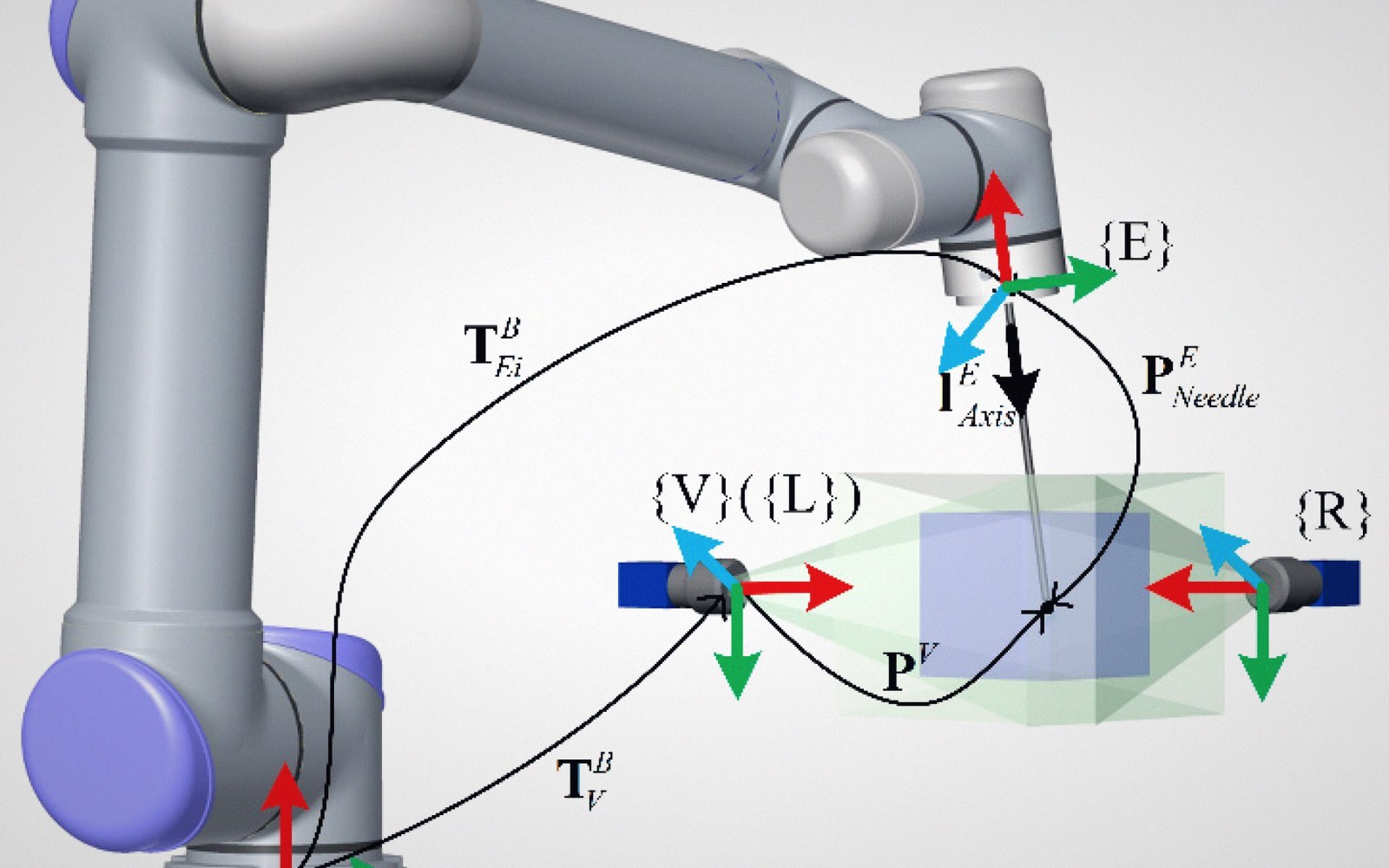
This defined point is called the tool centre point, universally abbreviated TCP. The name is slightly misleading: it need not be central, and it need not be at the tip. It is simply a position and orientation expressed as an offset from the robot's mounting flange — three distances along X, Y and Z, plus three angles describing how the tool's own coordinate frame is rotated relative to the flange. Six numbers. Get them right and the controller knows where the business end of the tool is at every moment, in every pose.
The practical consequence is immediate. When you command a linear move, it is the TCP that travels in a straight line while the six joints bend and compensate behind it. Rotate the tool around a fixed point — say, a welding torch around a seam — and it is the TCP that stays put while the wrist gyrates. Pull the TCP definition half a millimetre out of truth, and that rotation traces a small circle instead of a point, and every approach position in the program lands half a millimetre away from where it was taught.

Measuring the TCP accurately is therefore not a detail left to the end of commissioning. The standard method runs the arm at a fixed point in space from four or more different approach angles; the controller solves for the offset that keeps that fixed point consistent across all approaches. Any remaining scatter is the residual error in the TCP definition — and it feeds directly into the distinction between repeatability and accuracy that governs every claim made about the arm.
Change the tool, change the TCP. Change the TCP, re-verify the program before production restarts.
This defined point is called the tool centre point, universally abbreviated TCP.