§ 1When rigid is the wrong answer
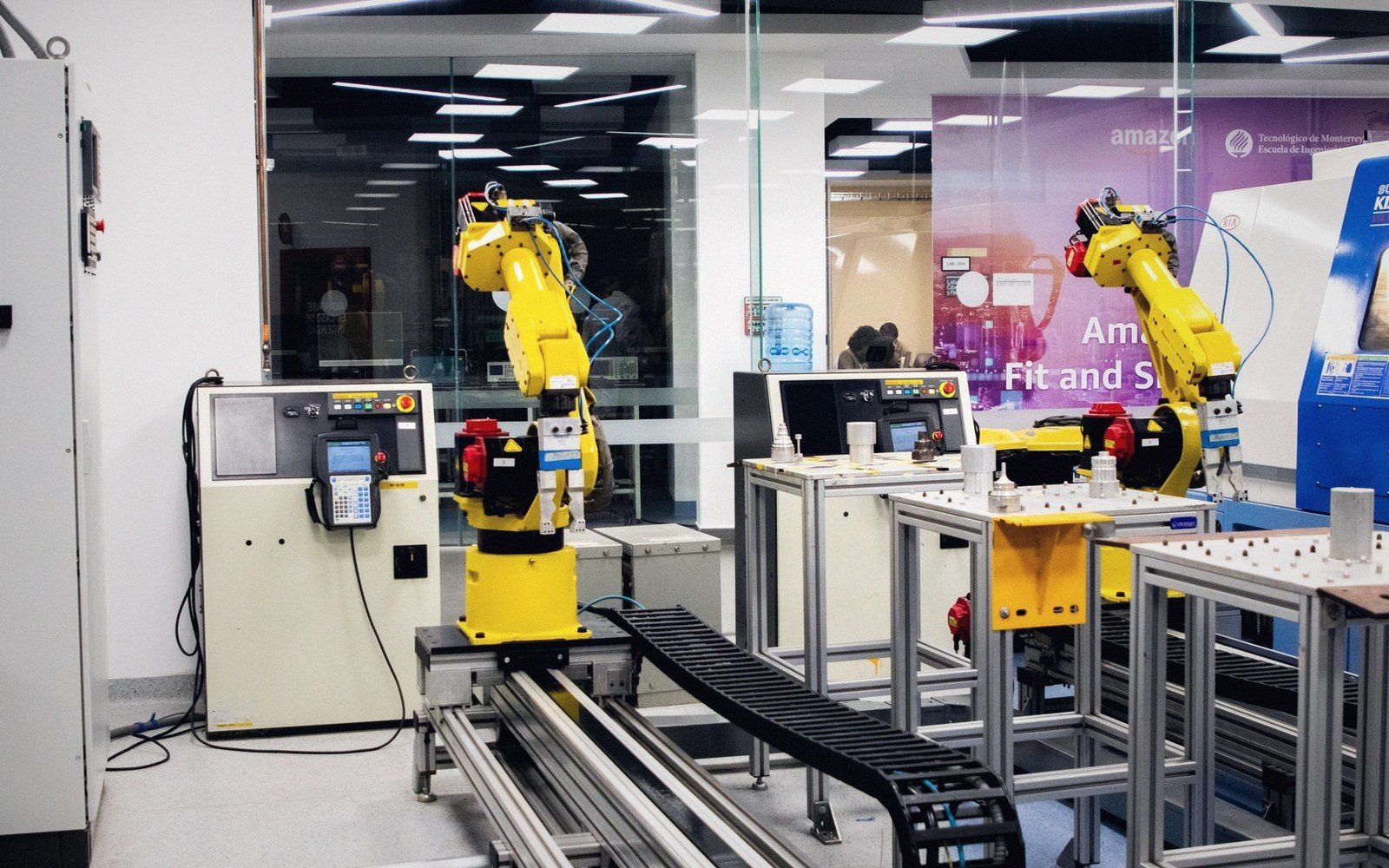
A rigid arm positioned to 0.03 mm repeatability will still jam a piston into a bore if the piston is off by a tenth of a millimetre. The arm does not know it has missed. It just pushes until something gives — and in a production cell, what gives is rarely the robot.
Compliance is deliberate springiness built into the tooling, the end effector, or a dedicated module between wrist and gripper. When the part is slightly misaligned, a compliant interface lets the tool shift, tilt, or both, so the part finds its seat rather than fighting it. The arm's programmed position stays fixed; the tool's actual position floats within a controlled range.
The canonical device is the remote centre compliance, or RCC. It is a passive mechanical insert — springs, elastomer discs, or crossed flexures — arranged so that a lateral force produces a lateral correction and a moment produces an angular correction, both pivoting about a point ahead of the unit at roughly the entry to the bore or socket being engaged. The geometry means a chamfered part edge, pressing against the hole, drives itself in rather than skidding across.

Stiffness in the compliant direction is a design variable. Too soft and the tool wanders under the weight of a heavy part; too stiff and the compliance is not enough to absorb the misalignment. Most passive RCC units are sized to a specific diameter range and part weight, which is why they are not interchangeable between assemblies without engineering review.
Active compliance replaces the passive mechanism with force–torque sensing and a control loop: the arm reads the contact force and adjusts its position in real time. This costs more and adds latency, but it works across a wider range and can log every insertion force as quality data.
What both approaches share is the same insight: a production cell has position tolerances stacked at every stage — fixture, part, previous operation — and adding them up may well exceed what even a well-calibrated arm can reliably absorb on its own.
The canonical device is the remote centre compliance, or RCC.