Vacuum against fingers
Suction is fast and forgiving on flat clean surfaces, and useless otherwise.

§ 1The choice that follows the part
A suction cup lifts a glass panel in under a tenth of a second. The same cup, aimed at a porous foam block or a curved casting, lifts nothing. The physics are unforgiving: vacuum gripping works by creating a pressure differential across a sealed contact area, and that seal demands a surface that is flat, smooth, clean and airtight. Meet all four conditions and suction is fast, light, cheap and remarkably repeatable. Fail any one of them and the cup either leaks down to nothing or never achieves a hold in the first place.
This is why the choice of end effector is really a choice made by the part, not the engineer. Sheet metal blanks, glass, cardboard cartons, injection-moulded lids, polished billets — these are natural suction territory. A cup makes contact, a venturi or pump evacuates the space between cup and part in milliseconds, and the arm moves. Release is equally clean: cut the vacuum, add a brief positive-pressure pulse, and the part drops without the arm having to linger.
Fingers — parallel or angular grippers driven by pneumatics or servo motors — survive the surfaces suction cannot touch. A porous, oily, textured or irregularly contoured workpiece gives a jaw something to close against; the grip force is mechanical and does not depend on a sealed interface. Fingers also conform well to cylindrical stock and to parts that must be picked from a pocket or a nest where a cup cannot get perpendicular to the surface.
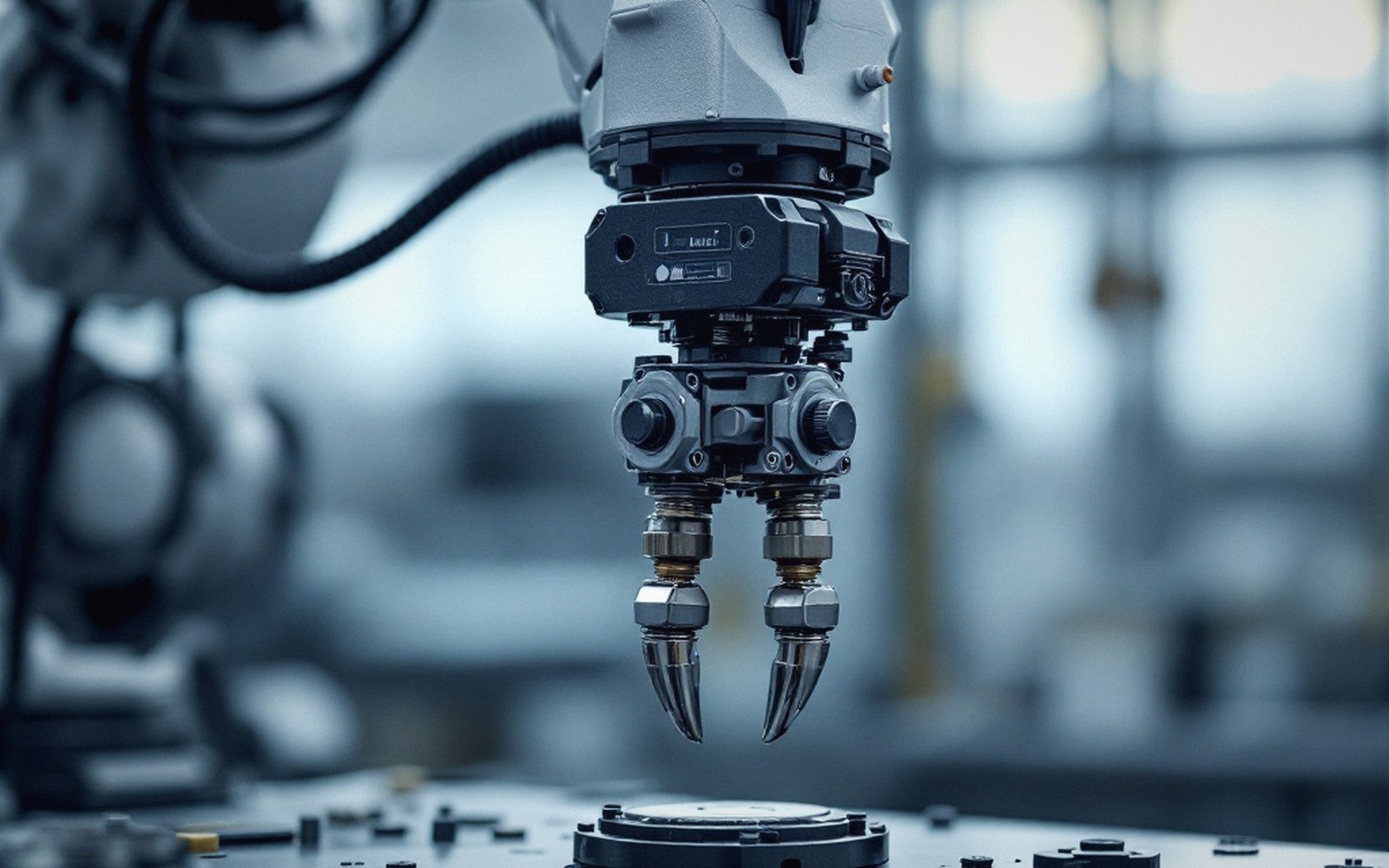
The cost is complexity. A gripper must be sized for the part, its stroke and force calculated against the payload and the forces seen mid-move. Unlike suction, which holds what it cannot feel purely from position inference, a servo gripper can be given torque feedback — which is not the same as genuine tactile sensing, but it is closer. Suction, by contrast, knows only that a vacuum is present; a part can be absent, cracked, or sitting at five degrees of skew and the signal looks identical.
Real cells often combine both: cups for the primary face, a finger or a locating pin to prevent rotation. The geometry of the part dictates the split, and any end effector that drifts on its tool centre point definition carries that error into every subsequent move.
The same cup, aimed at a porous foam block or a curved casting, lifts nothing.