
§ 1Three axes at a point, and why they have to meet there
The wrist of a six-axis arm is where attitude is settled. The shoulder and elbow place the tool roughly in space; the wrist's three axes — conventionally joints 4, 5 and 6 — rotate, tilt and spin it into the exact orientation the task demands. That sounds straightforward until you look at what those three axes have to share: a volume roughly the size of a clenched fist.
The geometry is the reason for the compactness. All three axes are designed to cross, or very nearly cross, at a common point. When that is achieved, rotating any one of the three wrist joints does not translate the tool-centre point — it only reorients it. The tip stays still in space while the hand changes angle. That property is what allows the controller to separate the orientation problem from the position problem and solve them independently. Move the axis intersection even a few millimetres off that ideal, and every reorientation becomes a small, coupled translation: the mathematics grows messier and the positional error at the tip grows with it.
The price of meeting that geometry in a compact package is mechanical density. Harmonic-drive reducers — thin, lightweight, torsionally stiff — displaced traditional gear trains in wrist joints precisely because they could deliver the high reduction ratios the wrist needs while fitting inside the narrow housing. The output of joint 5 carries the entire mass of joint 6 plus the end effector plus the payload; joint 4's motor and reducer must do the same for everything outboard of it. Each stage therefore has a weight and inertia budget that is strictly enforced by the designer, which is why wrist castings are often aluminium or magnesium alloy rather than the steel used at the shoulder.
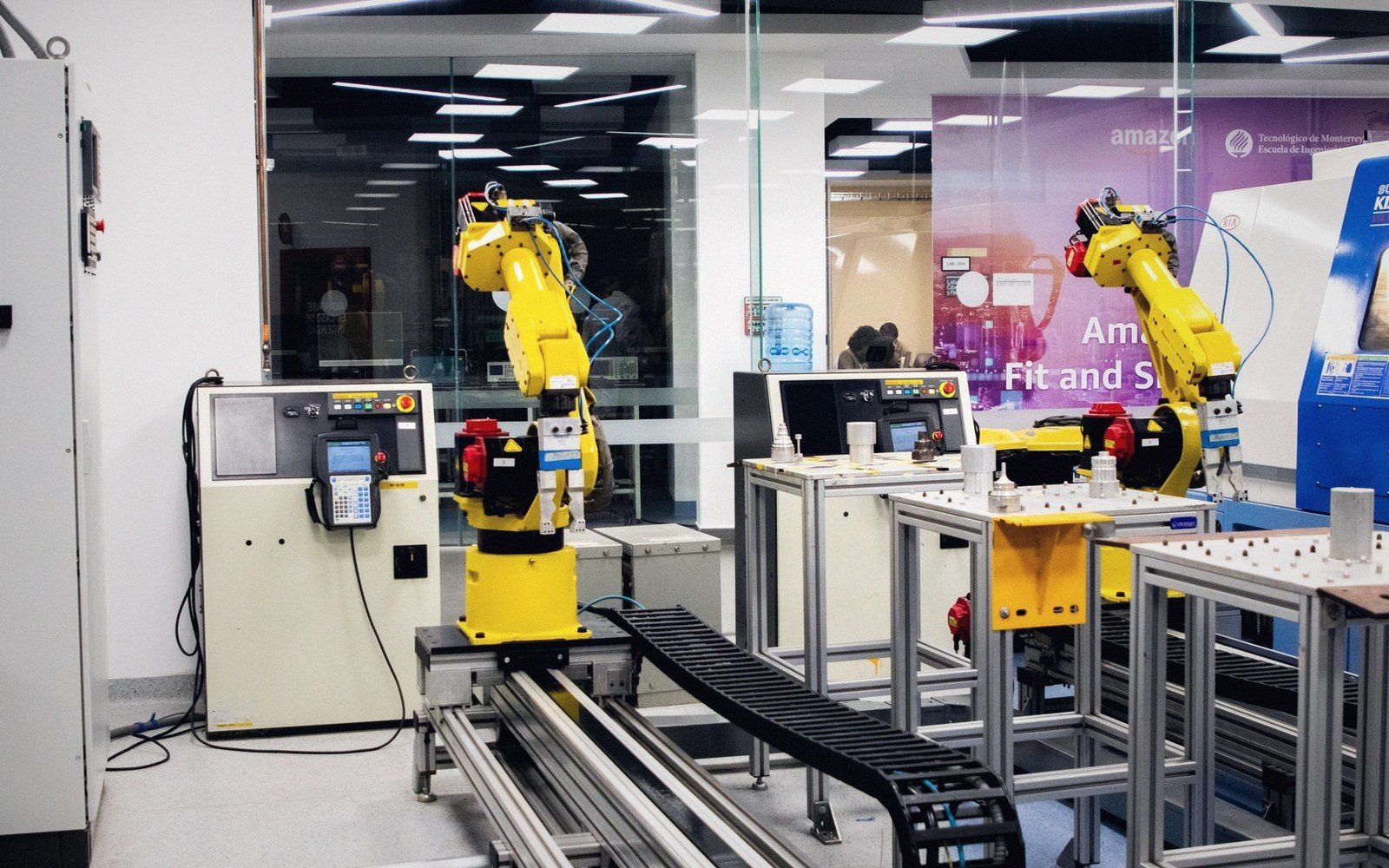
Routing power and signals through a rotating stack of joints adds another constraint. Cables and pneumatic lines must pass from the base all the way out to the flange without binding, kinking or fatiguing as the joints sweep through their ranges. Many designs hollow out the wrist to run the service loop through the centre of the joints rather than around the outside — a cleaner arrangement that limits what tool cables can snag on, but one that imposes a strict diameter limit on everything passing through.
The compactness that makes the wrist functional is also what makes it vulnerable near certain poses: when joint 4 and joint 6 align, the arm is at a wrist singularity, and the controller loses one effective degree of freedom. The geometry that lets three axes share a point is exactly the geometry that occasionally makes two of them indistinguishable.
The wrist of a six-axis arm is where attitude is settled.