Where the maths runs out
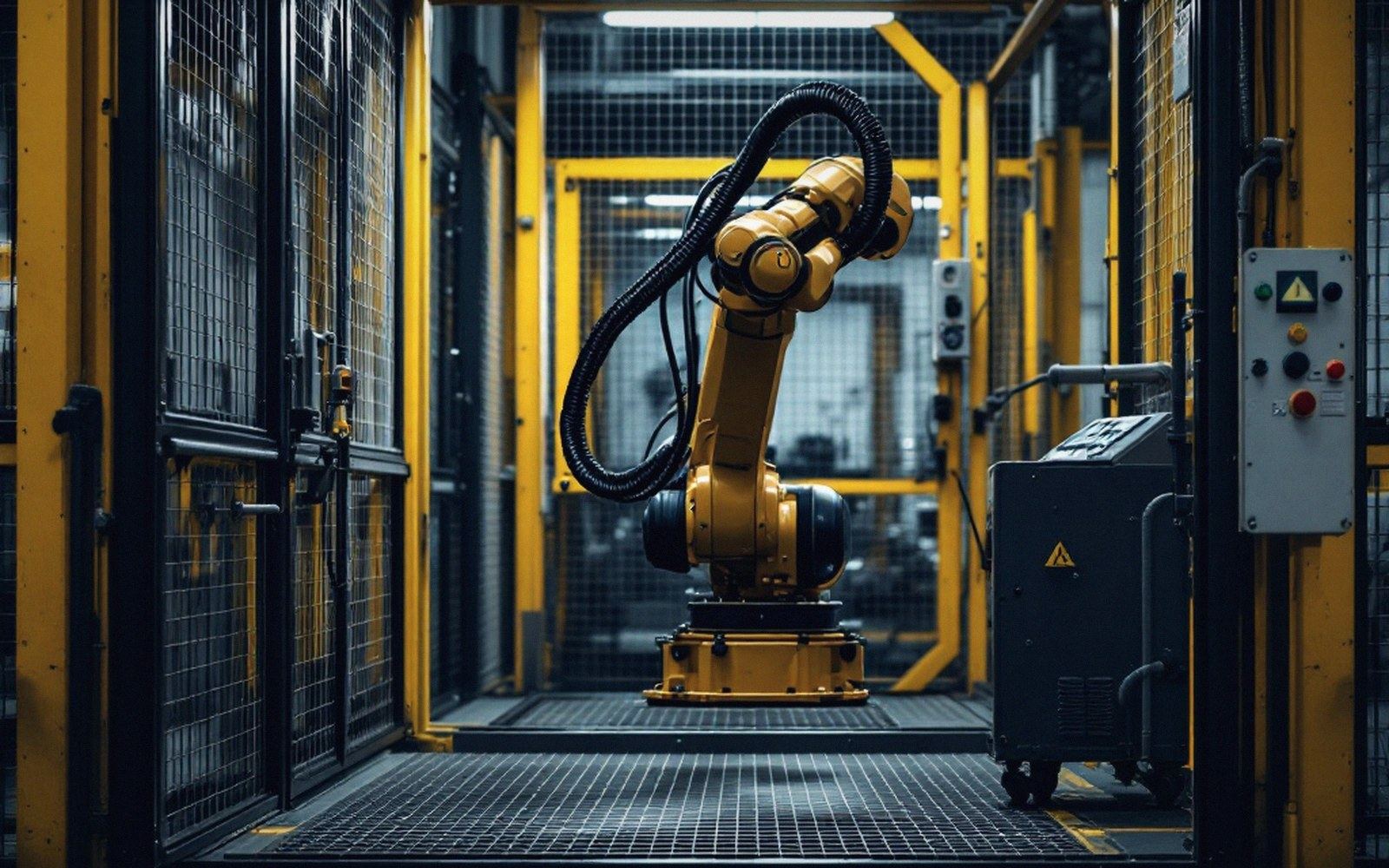
In certain poses two axes line up and the arm loses a degree of freedom — the controller demands infinite speed to continue straight through, and stops instead.
§ 1The geometry that breaks the calculation
A six-axis arm can place its tool anywhere in reach, at any angle, because six independent joints give six independent freedoms. Take one away — not by breaking hardware, but by letting two joints accidentally align — and the maths that translates a desired tool path into joint angles stops producing a single answer. It either finds infinitely many answers or none at all. Either outcome is a problem, and either can stop a cell mid-cycle.
The mathematics involved is called inverse kinematics: given a target position and orientation in space, work backwards to find the joint angles that achieve it. For most poses in the working envelope, this is a well-behaved calculation with a finite number of solutions. At a singularity, the Jacobian matrix used in that calculation becomes singular — its determinant falls to zero, and dividing by it is undefined. The controller is not confused; it is correctly reporting that the geometry has broken down.
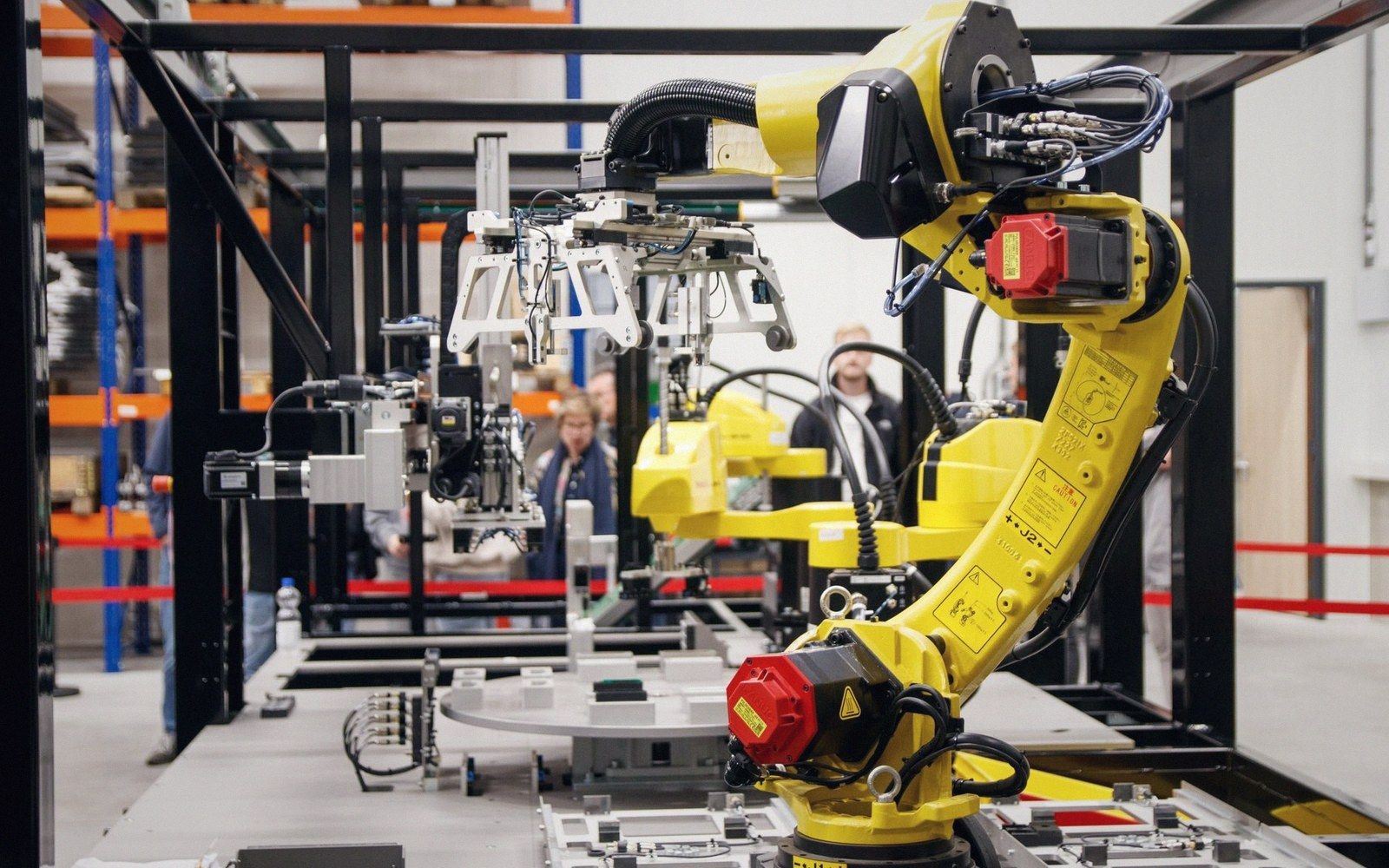
Three singular configurations recur regardless of which arm family you are working with. The first, called a wrist singularity, occurs when the fourth and sixth axes align: the wrist's middle joint has effectively been folded flat so the two outer joints fight over the same rotation. The second, a shoulder singularity, happens when the wrist centre passes directly through the vertical plane containing the first axis — the base rotation and the first arm joint are now competing for the same degree of freedom. The third, an elbow singularity, places the second and third joints in full extension or full fold so the elbow is locked straight out or tucked in; the arm's reach in that direction becomes instantaneously zero.
§ 2What the controller does, and why it matters
In an ideal mathematical world, passing through a singularity would require one or more joints to spin at infinite angular velocity for an instant. Real motors cannot do that. The controller catches the situation — typically by monitoring the condition number of the Jacobian — and responds by stopping motion, issuing a fault, or, in some trajectory-planning modes, deflecting the path slightly to avoid the degenerate pose.
That last option is called singularity avoidance, and it has a cost: the tool no longer travels the straight line you programmed. If the line passes through or near a singular configuration, the controller bends the path around it, and the deviation can be large enough to matter for a weld seam or a dispensed bead. This is why the location of singular poses is not academic — it is a path-planning constraint that determines whether a given approach direction is actually feasible.
The wrist flip is the most physically dramatic symptom a person near the cell is likely to see: an arm approaching a wrist singularity may suddenly rotate one joint by a large angle very quickly, because the planner has switched from one valid solution to another. Both solutions are mathematically correct on either side of the singularity, but the discontinuity between them can involve hundreds of degrees of joint motion even when the tool barely moved. Speed limits protect the hardware; the jolt is still alarming.
§ 3Living with the limits
Singularities are not defects. They are an inherent consequence of mapping a six-dimensional joint space onto the six-dimensional space of Cartesian position and orientation — unavoidable in any serial-link arm, present in the same three configurations whether the arm is small enough to sit on a benchtop or large enough to handle a car body. Planning around it is an engineering discipline in its own right: choosing tool orientations and approach vectors that keep every step of a programmed path away from degenerate poses.
The practical implication for anyone programming or commissioning a cell is that the working envelope is not simply a volume. It is a volume with internal structure — regions where motion is healthy, regions where it becomes ill-conditioned, and specific surfaces and lines where the maths, however correctly implemented, runs out entirely.
Citizen Robot is an independent publication about robot engineering. It is not a vendor, integrator or safety authority, and nothing here constitutes installation, commissioning or safety guidance.
Speed limits protect the hardware; the jolt is still alarming.