Planning around it
Choosing an approach that never puts the wrist in line with the shoulder.
§ 1A constraint you route rather than solve
A singularity is not a fault. It is a geometric condition — two axes aligning in a way that collapses the arm's ability to resolve a commanded Cartesian move into joint motion — and no software patch makes it go away. The only reliable answer is a path that never arrives there.
That starts with tool-centre-point placement. If the TCP sits well off the centreline of the wrist, the wrist rarely needs to pass through the aligned configuration to reach a given target. A small deliberate offset — a few degrees of tilt built into the tool mounting — shifts the working geometry enough that the singular pose either lies outside the useful workspace or requires a target position the part geometry simply never demands. This is the cheapest mitigation, and it costs nothing once the fixture is locked.
Frame orientation matters for the same reason. A robot mounted at a slight angle to the conveyor, or a part presented on a tilted fixture rather than flat to the floor, changes which poses the arm visits during a normal cycle. The singular poses do not move — the arm's geometry is fixed — but the task poses do, and with care they can be routed around the trouble. Programmers sometimes call this choosing the approach angle, but it is really a decision made at the cell-layout stage, not at the teach pendant.
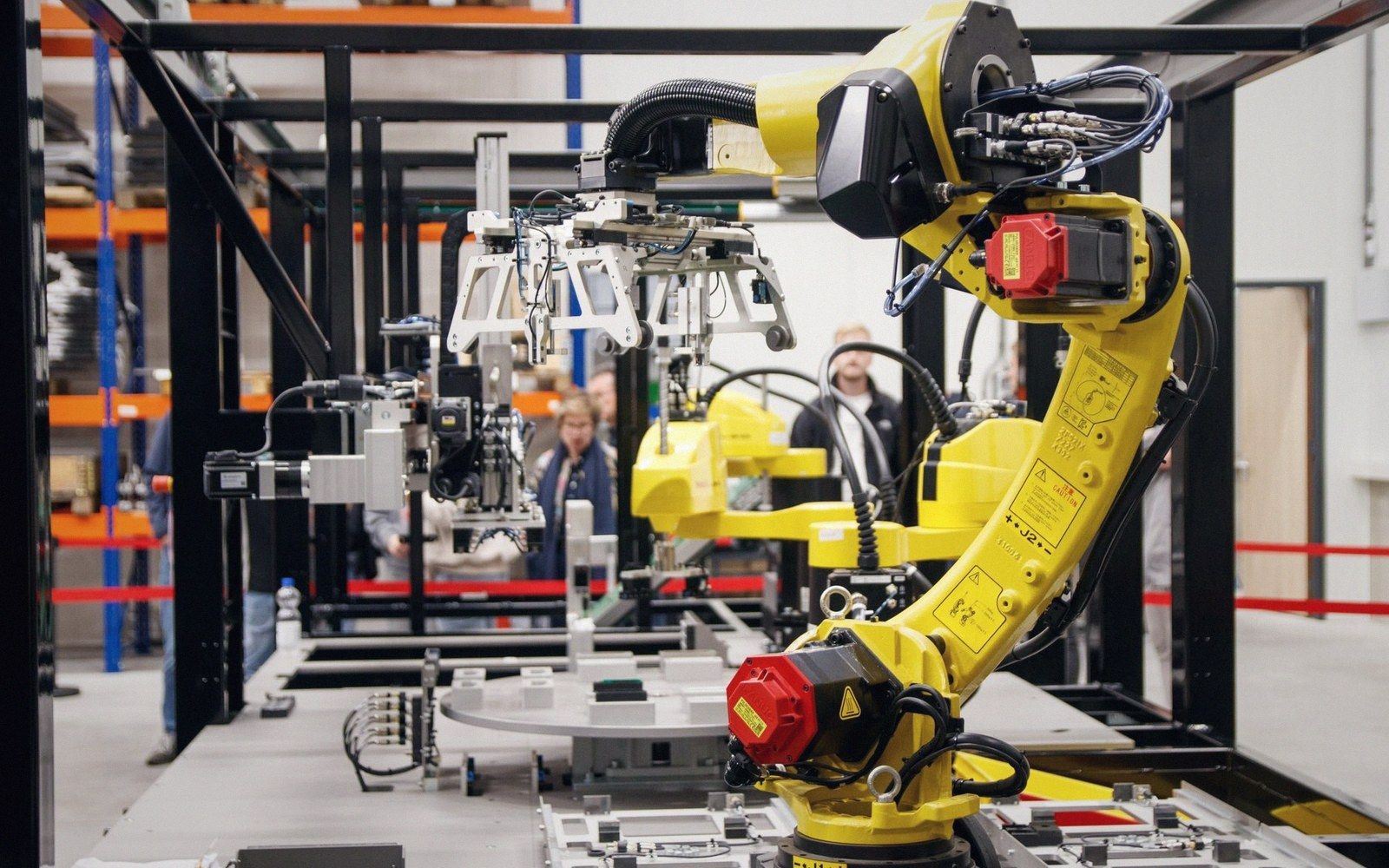
Path shape is the third lever. Where a straight-line Cartesian move would pass the wrist through or near the shoulder centreline — a long horizontal sweep across the robot's front, for instance — a curved path or a deliberate waypoint pulls the arm clear. The waypoint adds time, but a wrist flip or a controller deceleration to near-zero adds more, unpredictably, mid-production.
The practical rule is to treat where the maths runs out as a region to be excluded at layout, not a warning to be cleared at runtime. Simulate the full path before installation. Most offline programming environments will flag proximity to a singular configuration; take the flag seriously at the design stage, because moving a floor-mounted arm after commissioning is expensive and the geometry will not have changed.
That starts with tool-centre-point placement.