Wrist flip
The moment a path crosses a singularity, the controller does the maths and the wrist does the consequences.

§ 1What happens and why
A straight-line tool path sounds simple: the controller solves the pose at each interpolation point, works backwards through the kinematics, and moves the joints accordingly. For most of the path this is unremarkable. Near a singularity it is not.
The classic case is wrist singularity — the configuration where the tool is pointing directly away from, or directly toward, the base, so that joint four and joint six become aligned. In this configuration two axes line up and the arm loses a degree of freedom; the inverse kinematics no longer returns a unique solution. As the tool crosses through or near that zone, the answer to "which way is joint six pointing?" can flip from one extreme to the other in a single interpolation step. The tool position is maintained, or very nearly so — but joint six can command a rotation of close to 180 degrees between two points that are fractions of a millimetre apart on the path.
That rotation is the wrist flip. It is not a fault, not a mechanical failure, not a loose cable. It is the algebra doing exactly what it is supposed to do and the hardware faithfully following.
§ 2What it looks like, and what it costs
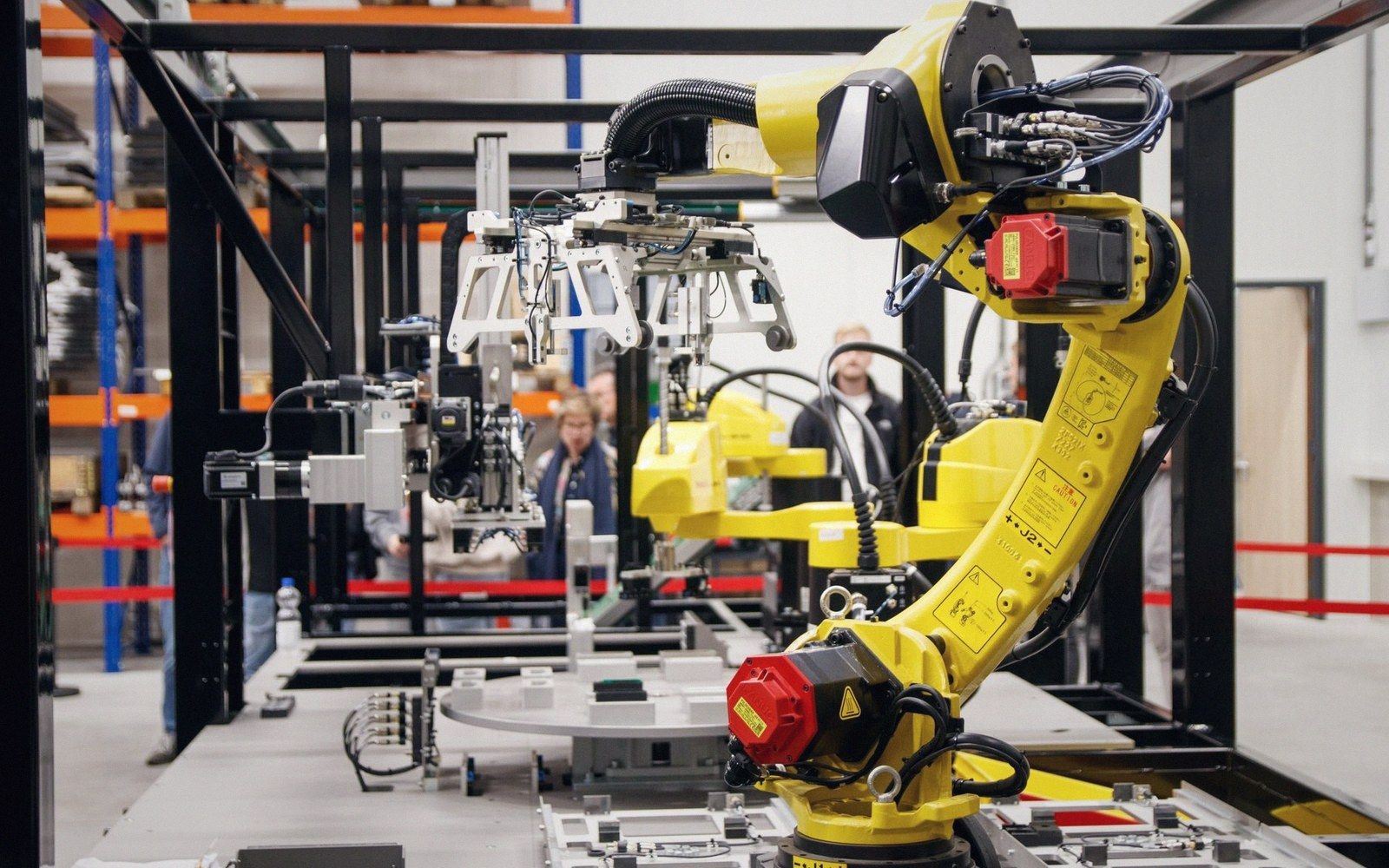
To a person watching the cell, the flip is startling — a joint that was moving slowly suddenly snaps through a large angle at or near its maximum speed. The tool centre point barely moves. Everything around it does. The consequence is speed: even though the end effector has not traveled far, the wrist links have moved fast, and the inertia involved is not trivial. The arm is briefly operating in a regime it was not designed to sustain continuously, and the mechanical stress is real. Do it on every cycle and the gearbox and motor at that joint accumulate wear at a rate the designer did not intend.
There is also the matter of any cable or hose bundle routed through or around the wrist. A rapid 180-degree oscillation, repeated tens of thousands of times, will fatigue a conduit that would otherwise last the life of the cell.
§ 3The fix is upstream
Wrist flip is not solved at the wrist. It is solved by choosing an approach that never aligns joint four and joint six — by shifting the path, rotating the base frame, or adjusting the tool angle just enough that the singular pose is never reached. A few degrees of deliberate offset in the taught path can eliminate the problem entirely. The flip is the symptom; the path is the cause.
It is not a fault, not a mechanical failure, not a loose cable.