Reach is not a sphere
The diagram in the datasheet shows a smooth solid. Reality has voids in it, and at least one of them sits directly in front of the robot.
§ 1The envelope has geometry, and the geometry has gaps
Every robot arm ships with a reachability diagram: a swept volume, usually rendered as a pair of arcs in side profile. It is tempting to read this as a statement that the arm can arrive at any pose inside that boundary. It cannot.
The first hole most people encounter is the dead zone directly behind the base — the region the arm cannot reach because the links physically collide with themselves. That gap is obvious once you see it, and most installers plan around it instinctively. The subtler problem is the zone near the arm's full extension, and the zone very close to the mounting flange.
At full extension, all the links are nearly collinear. The wrist, elbow and shoulder joints are nearly aligned. The arm can place the tool-centre point at that location, but it has almost no freedom to reorient it. Ask the tool to approach from a different angle and the controller has nowhere to go. The pose is reachable by position but not by attitude, and attitude is usually the point.
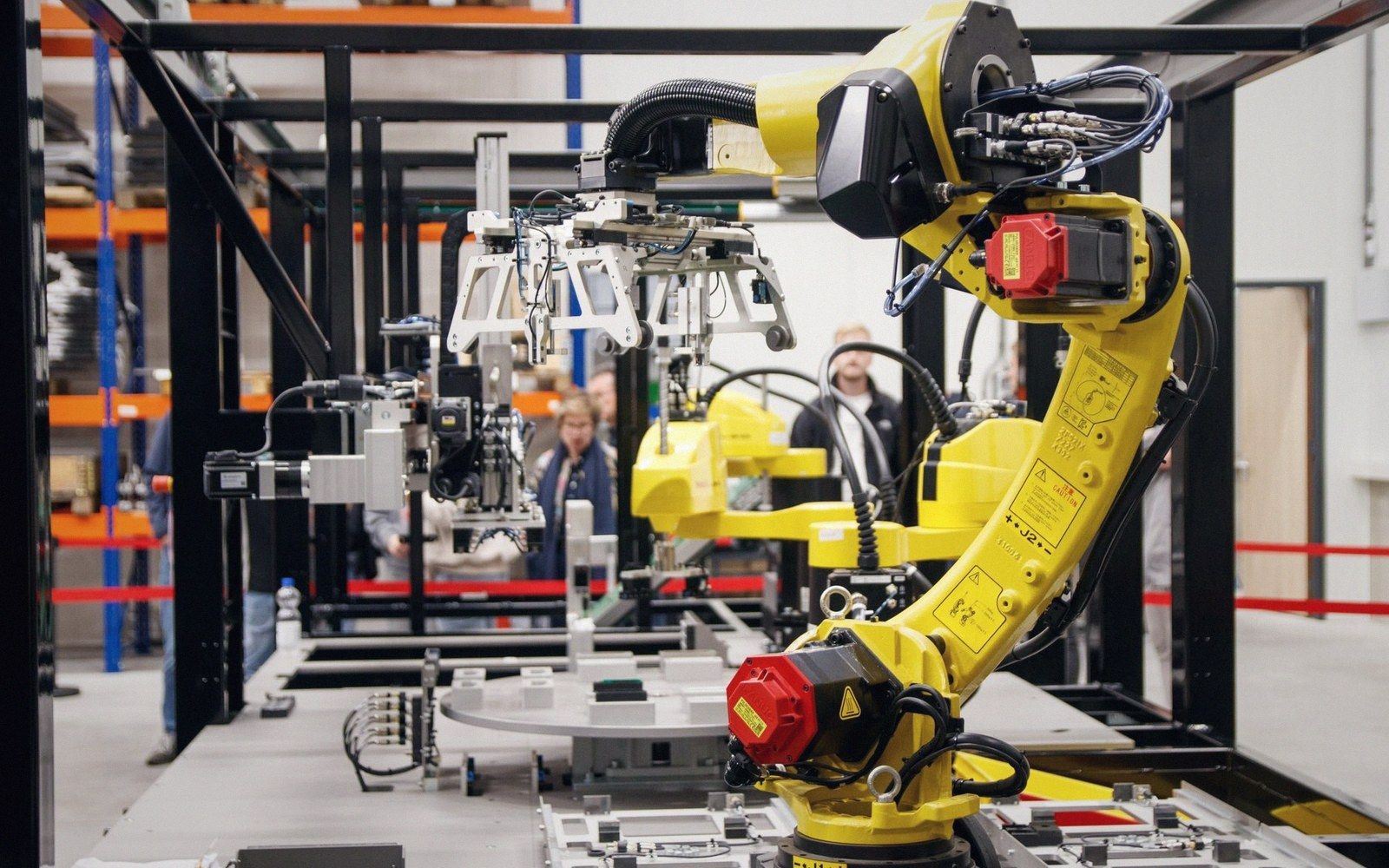
The zone close in front of the base, near the axis of the first joint, is where a subtler geometry problem lives: the overhead singularity and the wrist singularity can both be approached from here depending on arm configuration. Where the maths runs out is not just a theoretical note — it maps onto physical regions of the envelope. The Jacobian matrix, which translates joint velocities into tool-centre velocity, becomes ill-conditioned in those regions. The controller either slows the arm dramatically, stops it, or demands impossibly high joint speeds to maintain the commanded path. What looks on the datasheet like usable volume is, in practice, a zone the path planner will refuse or distort.
There is also a subtler shape issue: the envelope varies with configuration. A six-axis arm can reach the same point in space with the elbow up or elbow down, with the forearm flipped or straight. Which configuration the arm is currently in determines which parts of the quoted envelope are actually accessible from that pose without a configuration change — and a configuration change mid-path is not a smooth move.
The practical consequence is that when a workcell is laid out, the robot's position relative to its fixtures should be chosen so that the working path sits in the fat middle of the envelope, nowhere near full extension and nowhere near the base. The datasheet volume is a ceiling, not a floor plan. Treating the smooth arc diagram as a usable workspace boundary, rather than an absolute outer limit, is the error that shows up in late-stage commissioning when there is no longer room to move anything.
At full extension, all the links are nearly collinear.