Why six
Three joints to put the tip anywhere, three to point it any direction. Six is not arbitrary — it is the minimum that leaves nothing out.

§ 1Placing the point, then pointing the tool
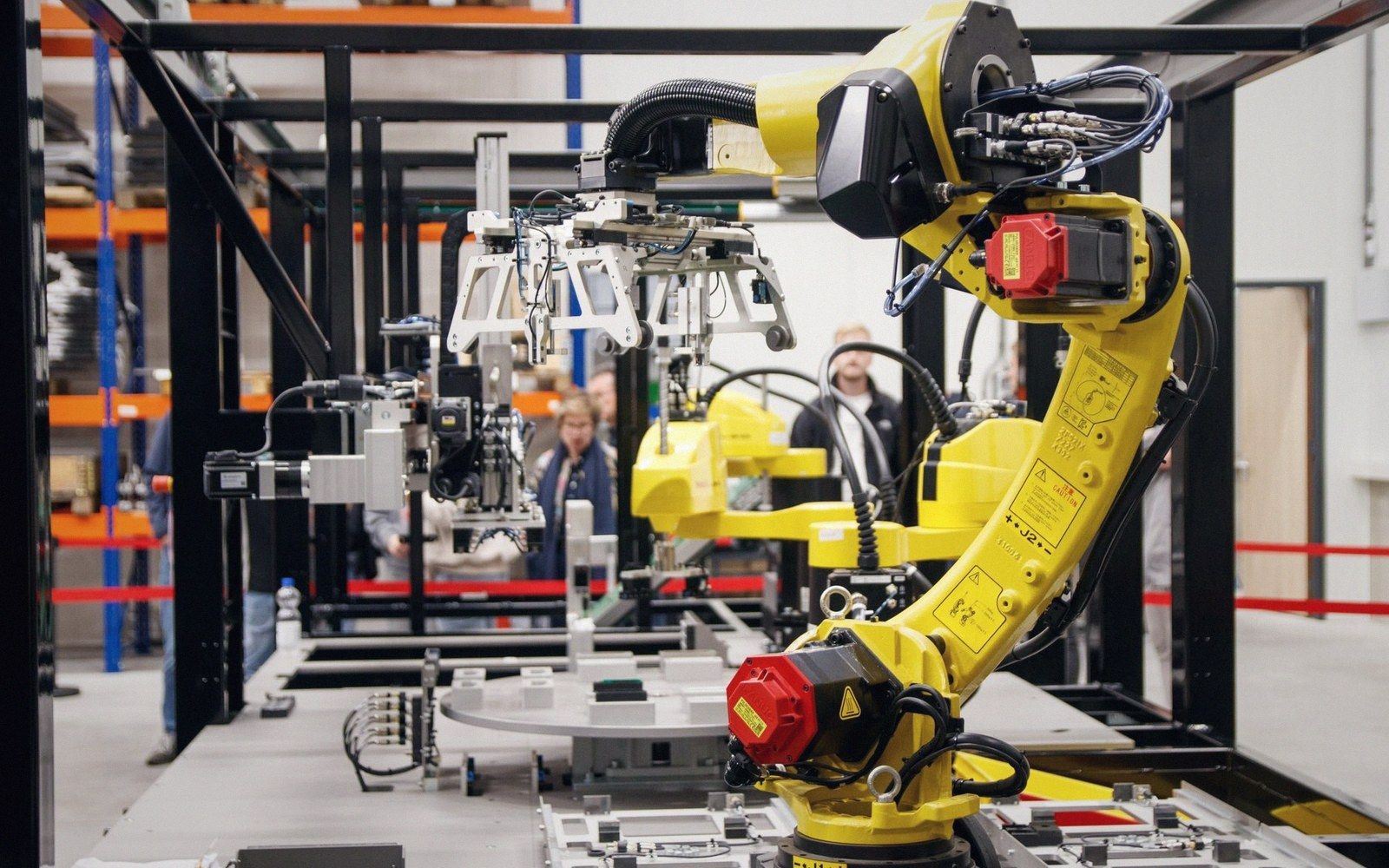
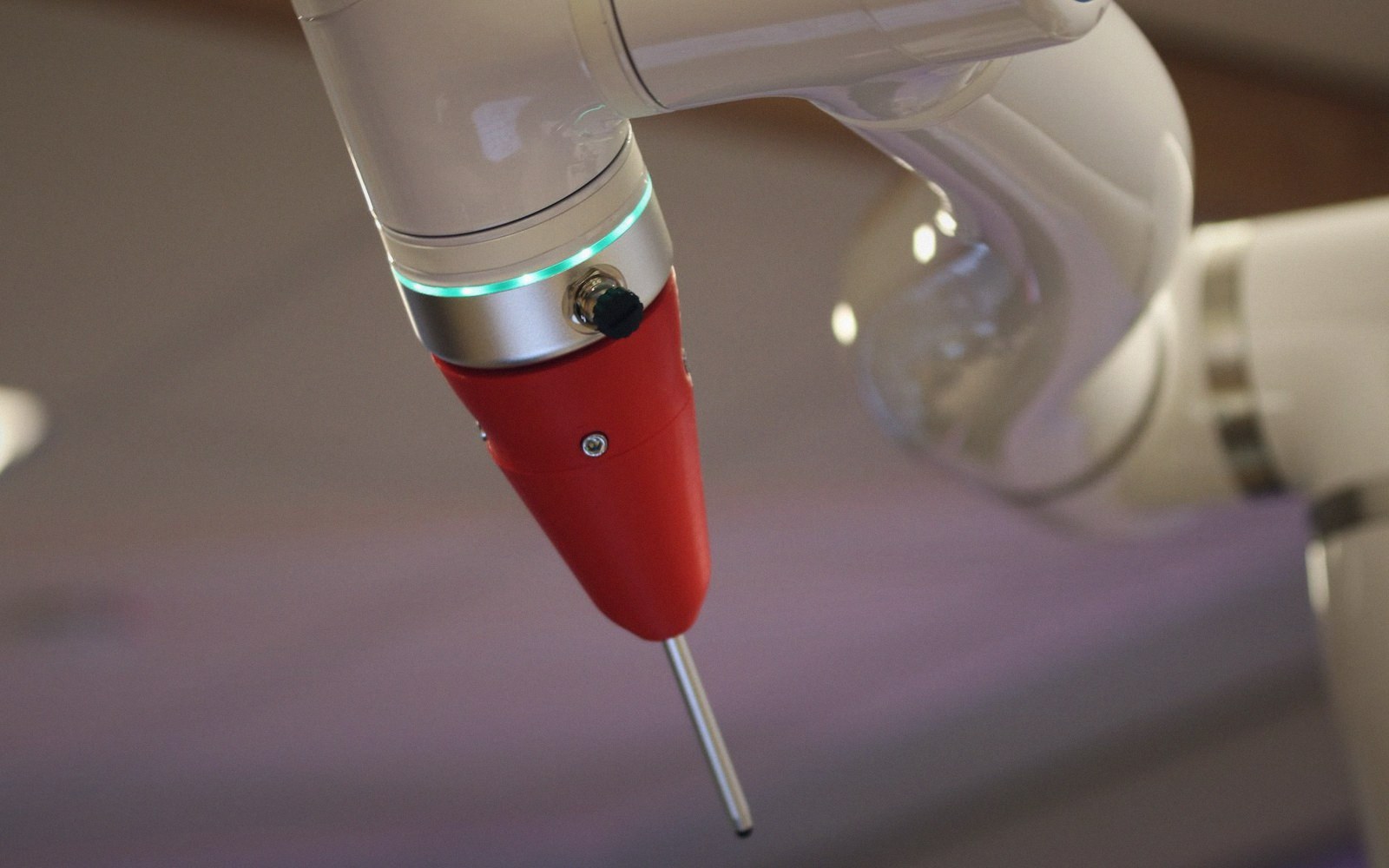
A robot arm's job is to put a tool into a precise position and attitude. Position alone is three numbers — x, y, z in space. Attitude is three more — roll, pitch, yaw. Six independent values, six independent joints. The arithmetic is not a coincidence.
Think of it in two stages. The first three joints — shoulder rotation, shoulder flex, elbow flex — are the gross movers. They sweep the wrist centre to wherever you need it in the working volume. Call this the positioning chain. The last three joints, crossing close together near the wrist, handle orientation: they can tip, tilt and spin the tool without moving that wrist centre more than a fraction. The shoulder carries the arm out to the right place; the wrist finishes the job by pointing it correctly.
This division is clean in theory and slightly blurred in practice — moving a wrist joint does nudge the tip position by a small amount — but the principle holds well enough that engineers design around it. The first three joints are specified for reach and payload; the last three for angular range.
§ 2Fewer is constrained, more is redundant
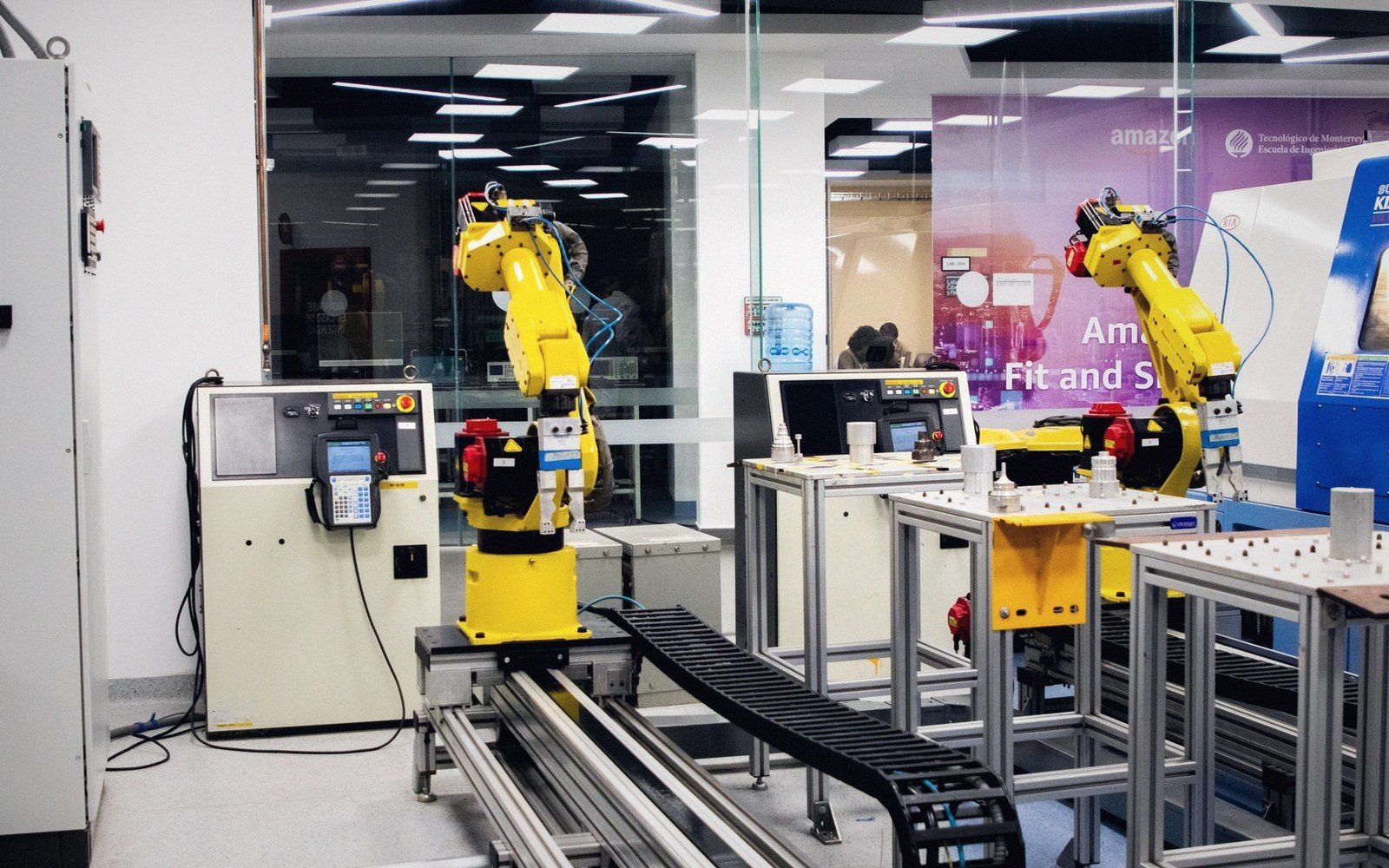
Drop to five axes and something is lost. A five-axis arm can still reach most points in its envelope, but it arrives at each one with a constrained orientation. There is always one angular freedom it cannot independently set — the tool attitude and the path to get there become coupled in a way that creates blind spots. For a task where the tool angle genuinely does not matter — a simple pick-and-place onto a flat surface, say — five axes can be enough. For welding a curved seam, screwing a fastener at an awkward angle, or inserting a connector that must approach on a specific axis, five is limiting in ways that show up as unreachable poses rather than error messages.
Go the other way and add a seventh axis, and the problem flips. Now there are more degrees of freedom than the task requires, and the solution for any given pose is no longer unique. An infinite family of joint configurations all place the tool in exactly the same position and attitude. The controller must pick one by some additional criterion — minimum joint travel, avoidance of a known obstacle, keeping clear of a singular zone. That is mathematically solvable but computationally heavier, and in a production cell it introduces choices that must be managed carefully so the arm does not surprise you by reconfiguring between cycles. Seven-axis arms exist and they solve real problems, mostly the ability to reach around obstructions in cramped cells. But they are chosen for specific reasons, not as a default.
Six is the number that makes the solution both complete and unique for any reachable, non-singular pose — one answer, fully determined. That uniqueness is what makes programming straightforward and behaviour predictable.
§ 3What the joints contribute individually
The base rotation sweeps the arm through its azimuth, covering the full circle around the pedestal. Shoulder and elbow pitch the arm up, down and outward, defining how far the wrist centre sits from the base and at what height. Together those three have already done the heavy positioning.
The wrist then has three rotations that ideally cross at a single point. The first two tilt the tool in two planes; the outermost spins the tool on its own axis. With all three working, you can aim the tool at any target from any compass direction — point it straight down, straight sideways, or at forty degrees while canted fifteen degrees to the left. No combination of fixed attitude is excluded, with the caveat that certain poses bring two of these axes into alignment and the arm briefly loses a degree of freedom — a condition with its own name and its own countermeasures.
Six axes, then, is not a convention that could easily have gone another way. It is the minimum count that covers all of three-dimensional orientation without arbitrarily locking one angle, and it is the maximum that leaves the inverse problem with a unique solution. Every axis has a clear job; none is spare. That economy is, in engineering terms, something close to elegance.
Position alone is three numbers — x, y, z in space.