Thermal growth
Steel expands as it heats. The arm that was dialled in during warm-up is a different arm four hours into the shift.

§ 1The hour that changes everything
A robotic arm is made of steel, aluminium and cast iron — all of which expand when warm. The coefficient of thermal expansion for steel is roughly 12 micrometres per metre per degree Celsius. That sounds trivial until you consider that a six-axis arm with an extended reach of 1.5 metres, warming by 10 °C across a shift, will see its links grow by fractions of a millimetre that are directly comparable to the repeatability figures quoted in the datasheet.
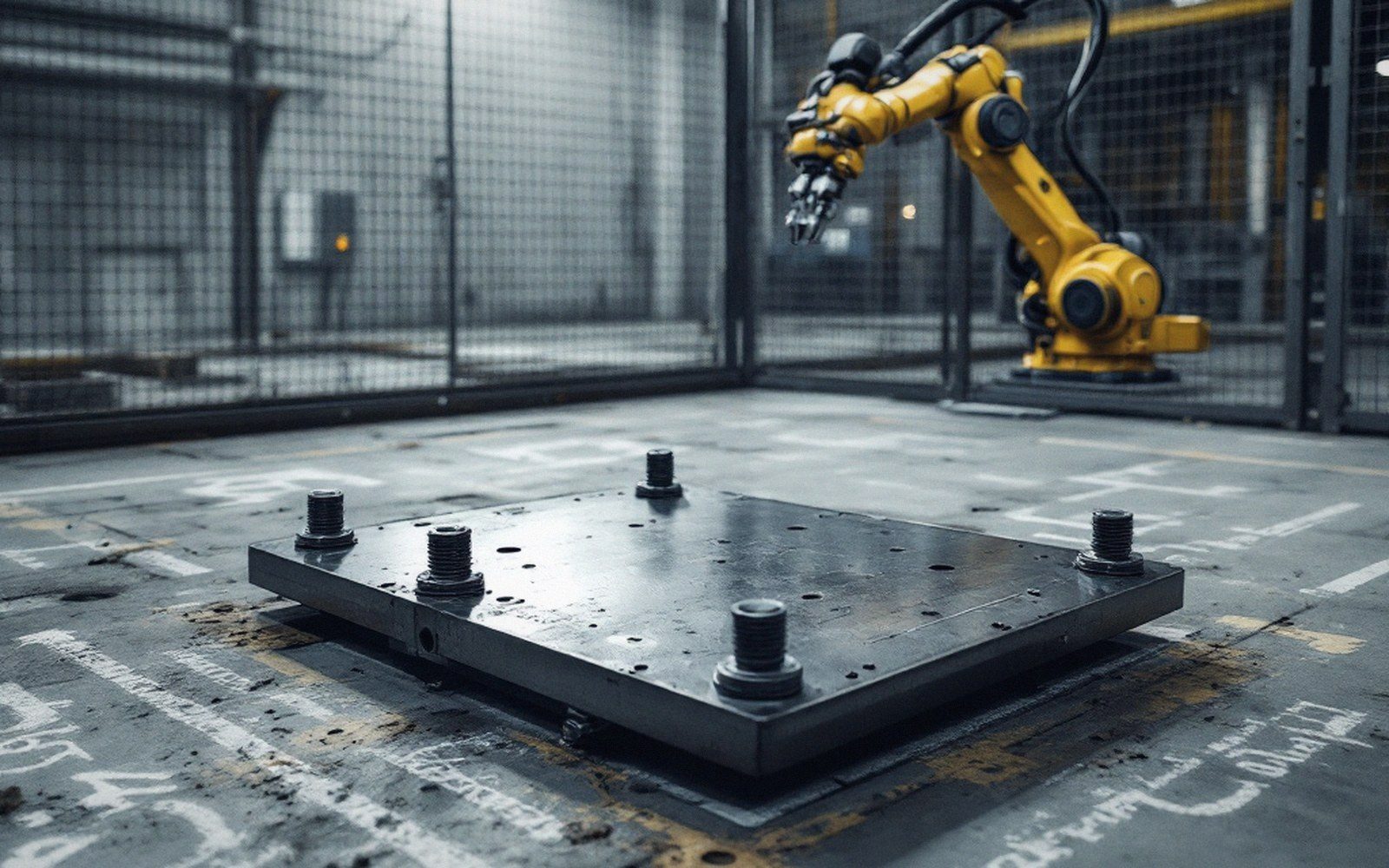
The heat sources are everywhere and they are constant: the servo motors at each joint dissipate power as heat, the gearboxes add more, the control cabinet radiates into the cell, and the production environment itself — welding arcs, ovens, hydraulic presses, even sunlight through a rooflight — loads the structure unevenly. The arm does not warm uniformly. The base, bolted to a concrete floor, stays relatively cool. The upper arm and wrist, running fast and carrying load, climb faster. A thermal gradient along the kinematic chain means each link has expanded by a different amount, and the cumulative error at the tool tip is not easy to predict without measuring it.
The practical result is this: a program taught cold, or taught after a brief warm-up, will drift as the machine reaches thermal equilibrium. Weld puddles creep, adhesive beads wander, pick positions that cleared a lip with a millimetre of daylight begin to clip it. The arm is returning to the same encoder counts — its repeatability is unchanged — but the physical position of those counts has shifted. The machine is doing exactly what it was told; the problem is that the geometry it was told in no longer exists.
Equilibrium typically arrives somewhere between forty-five minutes and two hours into a running shift, depending on the arm's size, the ambient temperature, the duty cycle and the thermal mass of the surrounding structure. The first hour of production is therefore the least predictable, and any process with tight tolerances should be validated during that window, not just at mid-shift.
The standard industrial response is a warm-up routine: the arm runs a representative cycle at normal speed for a defined period before production begins, bringing the structure to something close to its working temperature before the first good part is demanded. Some controllers log servo temperatures and apply compensation; some integrators embed reference artefacts in the cell and run periodic probe cycles to detect drift. None of this eliminates thermal growth — it manages the window in which the geometry is stable enough to be trusted.
The quoted figure does not include any of this. It never does.
The base, bolted to a concrete floor, stays relatively cool.