§ 1The number that matters
A standard industrial robot in automatic mode moves fast enough that a person cannot reliably detect, react to, and escape a collision. The physics of this are straightforward: a heavy arm accelerating through a metre of arc delivers a lethal impact before any human reflex loop closes. Guarded automatic mode solves this by keeping people out. Reduced speed solves a different problem — what happens when someone must be in.
Teaching, verification, maintenance, tool change: all of them occasionally require a person inside the cell with the arm powered and capable of motion. Reduced speed mode limits that motion to a maximum of 250 mm/s at the tool centre point, a figure set by international safety standards rather than by engineering convenience. At that velocity a person can perceive the movement and pull clear before significant force accumulates. The 250 mm/s limit applies to the TCP; individual joints may still be moving, so the programmer must be aware that a slow wrist rotation combined with a long tool can still produce a TCP velocity that exceeds the limit if the controller is not enforcing it correctly.
The mode typically requires active consent: the operator holds an enabling device — usually a three-position grip that cuts power if released entirely or if squeezed too hard. Let go in panic, or freeze and grip harder in panic, and the arm stops either way. Movement then proceeds only while a separate jog input is held. Both inputs must be present simultaneously; neither alone is sufficient.
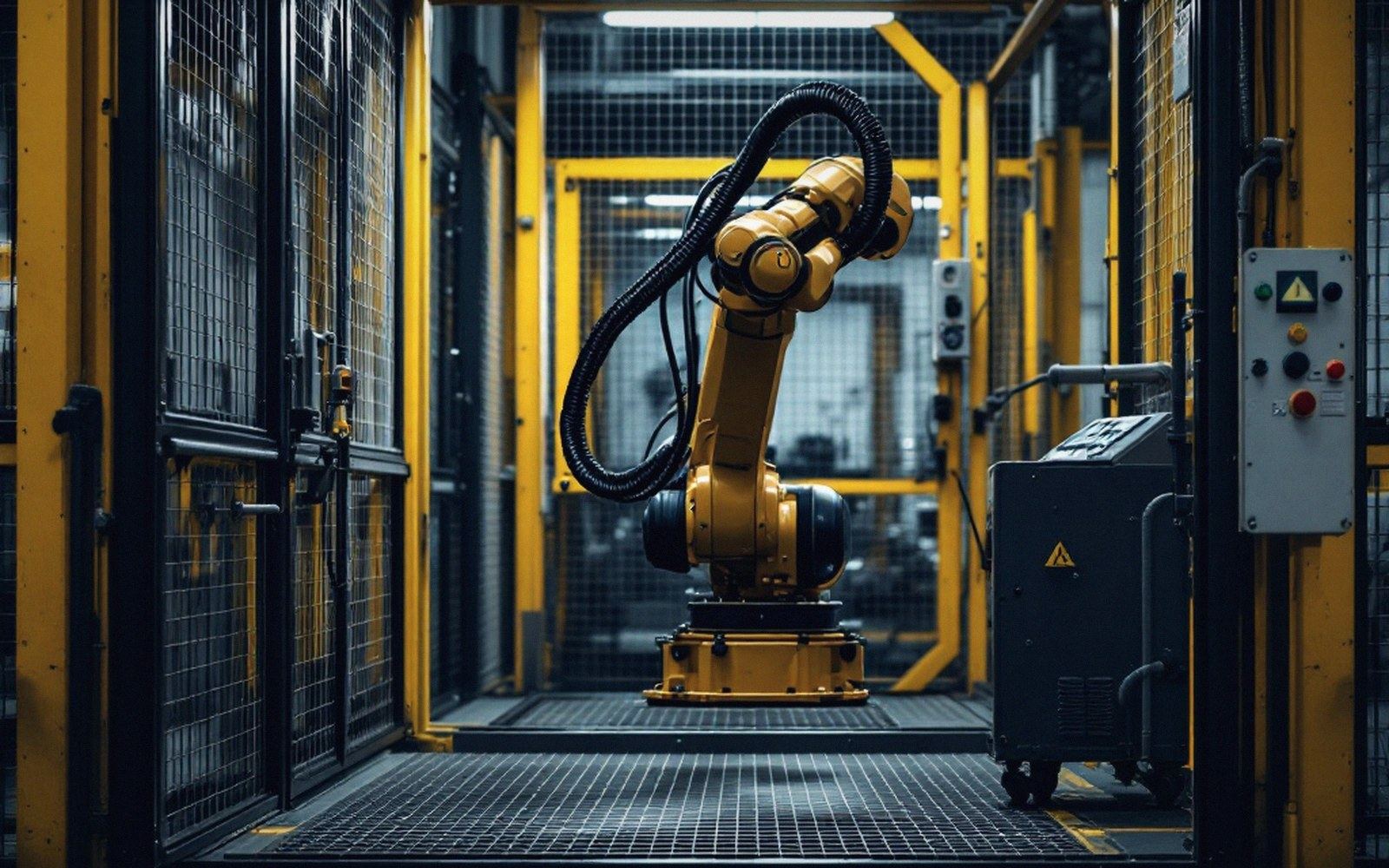
Reduced speed is not a safe-to-touch state. Even at 250 mm/s a robot arm is not designed to stop on contact — it is designed to stop before contact, via the path the programmer has verified. The mode creates a window of time in which a person can react. It is, precisely and only, that: a window, not a guarantee.
Citizen Robot is an independent publication about robot engineering. It is not a vendor, integrator, reseller or safety authority.
Guarded automatic mode solves this by keeping people out.