Light curtains and scanners
Two ways of noticing that something has entered, with different response times.
§ 1Two ways of knowing the envelope has been broken
A guarded cell needs a way to detect intrusion before the arm reaches whatever entered. Two technologies dominate: the light curtain and the safety laser scanner. They work on opposite principles and suit different geometries.
A light curtain is a vertical array of infrared beams, transmitter on one side, receiver on the other, spanning the full height of an opening. Break any beam and the output drops immediately — response times are typically a few milliseconds, fast enough that the arm can be brought to a safe state before a hand travels the distance to risk. The curtain is passive in the sense that it only guards a fixed plane. Fit it at a door or a conveyor opening and it handles exactly that gap, nothing else. Its simplicity is its reliability: there is almost nothing to go wrong, and safety-rated curtains carry dual-channel outputs precisely so a single component failure does not produce a silent loss of protection.
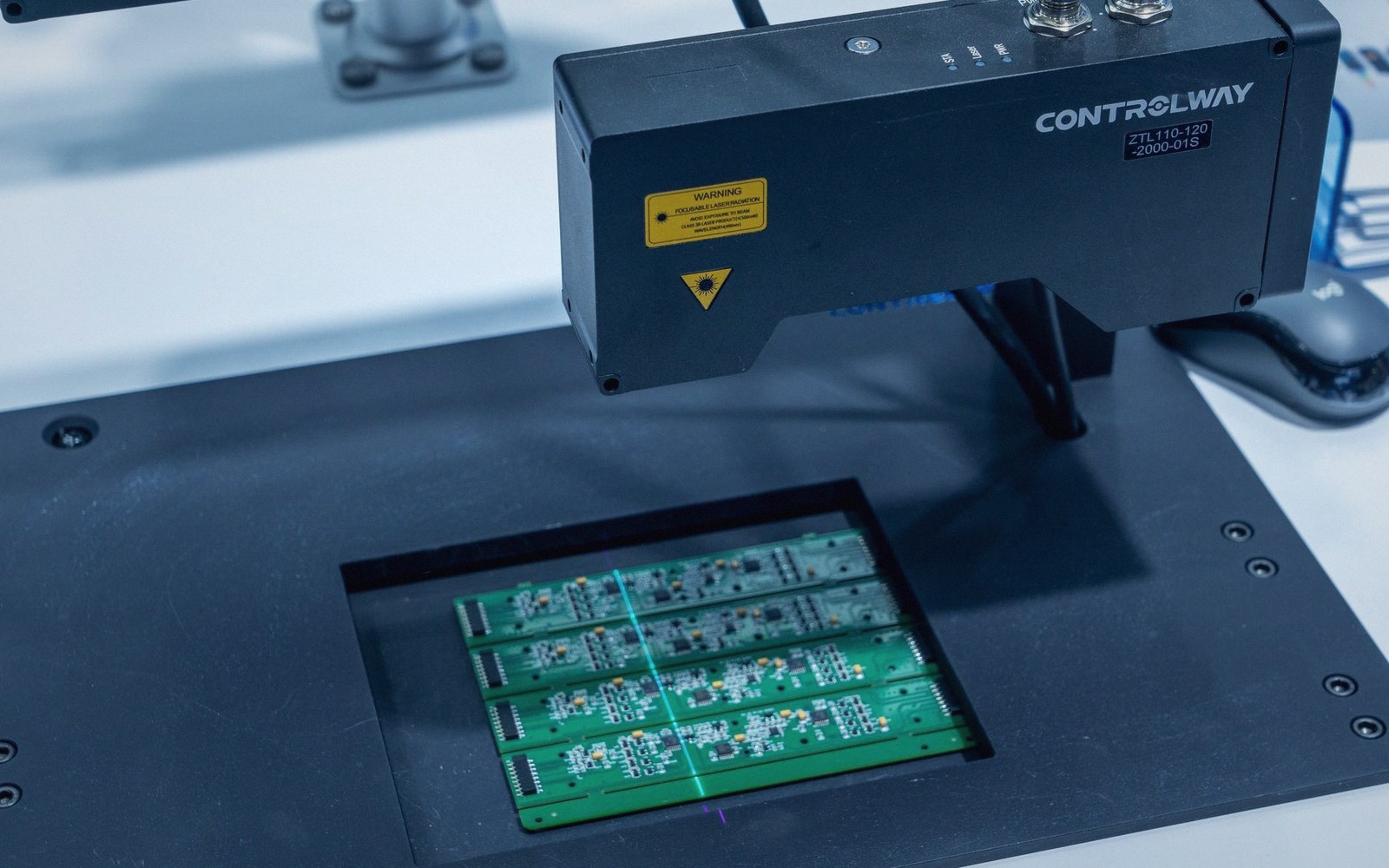
A safety laser scanner sweeps a single infrared beam through an arc — typically 270 degrees — and times the reflections. Software turns those times into distances, and the controller compares every scan against one or more configurable zones. The first zone triggers a slowdown; a closer zone triggers a stop. Response times are longer than a curtain's, measured in tens of milliseconds rather than a few, which matters when calculating the minimum distance between the scanner and any hazard. The upside is flexibility: the protected area is a shape drawn in software, adjusted for different fixtures, different part sizes, different tasks. A scanner can also distinguish a standing operator from a passing forklift, which a curtain cannot.

Neither device replaces fencing. Both are used in combination with hard guarding — the scanner covers a floor zone that a fence cannot, the curtain guards a gap the fence deliberately leaves for material flow. The fence is part of the machine, and these sensors extend it rather than replace it.
Choosing between them comes down to geometry and cycle. A fixed narrow opening asks for a curtain; an open floor approach with variable access patterns asks for a scanner. In practice, many cells have both.
They work on opposite principles and suit different geometries.